
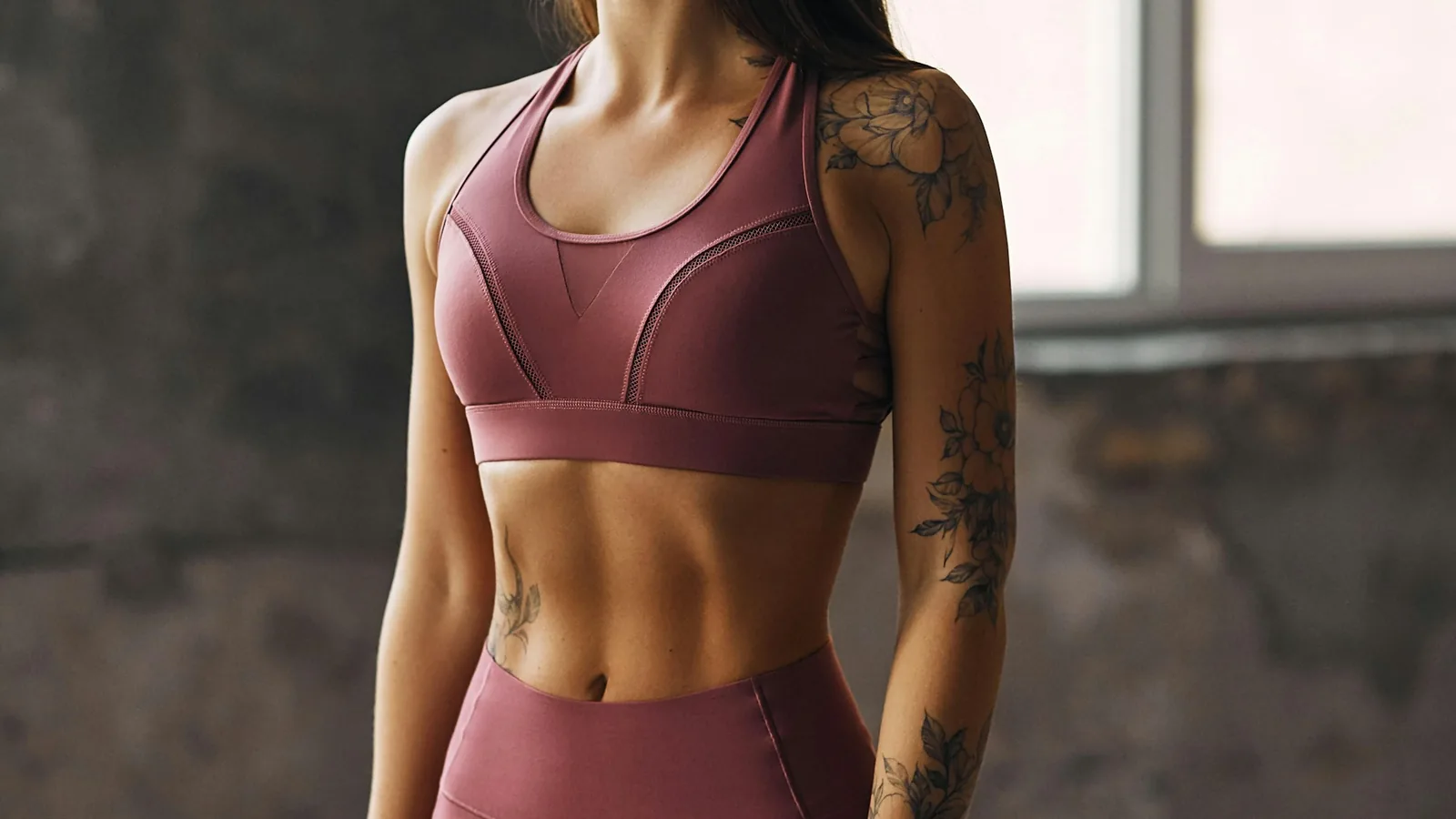
Compare sports bra support systems, fit, stretch materials, straps, backs, pads, seams, and movement-based validation across sizes.
A sports bra is an engineered stretch garment whose fit must be evaluated during movement. Neckline, cup or front panel, underband, straps, back, seams, and material recovery work as one support system. Labels such as low, medium, or high support are useful merchandising language only when the brand defines and validates what they mean for the actual product and intended activity.
Understand the main support systems
Compression styles hold the bust closer to the torso through stretch fabric and panel tension. Encapsulation styles create more individual shaping through separate cups or internal frames. Combination styles use both approaches. Longline designs extend the underband area, while crop-style bras may add more torso coverage without necessarily adding more functional support.
A removable pad changes modesty and shape but should not be mistaken for the complete support system. Underwires, molded components, bonding, slings, stabilizers, and power mesh can be used in specific designs. Every component affects fit, care, and manufacturing method.
| Direction | Construction idea | Useful for | Primary review |
|---|---|---|---|
| Light compression | Simple stretch body and underband | Lower-movement activity or layering | Coverage and recovery |
| Panelled compression | Mapped front and side panels | Broader activity range | Seam position and directional stretch |
| Encapsulated | Shaped cups or internal support pieces | More defined fit and separation | Cup grading and component stability |
| Longline | Extended underbust section | Coverage and styling | Band rolling and torso movement |
| Adjustable | Hooks, sliders, or convertible straps | Greater fit flexibility | Hardware comfort and adjustment range |
Build fit around underband, cup, and coverage
The underband provides an important anchor. Record its relaxed and extended measurements, width, elastic quality, and recovery. It should remain level during movement without excessive pressure, rolling, or upward travel. A longer band spreads contact over more area but can still roll if the pattern, elastic, or torso shape is wrong.
Front width, neckline, armhole, side height, and back coverage influence containment. Cup or panel volume must be graded rather than simply enlarged in every direction. If alpha sizing such as S-XL is used, define the body and bust range intended for each size and decide whether separate cup groupings are needed.
Fit sessions should include wearers representing the planned size range and the intended activity. Review breathing comfort, arm movement, bending, jumping or running where relevant, neckline security, underarm rub, strap position, band movement, and removal after exercise.
Choose materials for stretch, recovery, and opacity
Main fabrics are often nylon- or polyester-based stretch knits, but construction and finishing matter as much as fiber. Evaluate stretch percentage and force in both directions, recovery, weight, opacity, moisture behavior, pilling, snagging, colorfastness, and shrinkage. White and pale colors may require additional opacity review.
Power mesh can provide ventilation or reinforcement depending on its weight and tension. Linings may improve coverage, manage pads, or stabilize selected zones. Elastics, binding, thread, and bonding films must extend with the garment and recover. A material combination should be tested as an assembled sample because stiff seams can interrupt otherwise comfortable stretch.
Design straps, backs, and openings for use
Racerback, straight, cross-back, halter, and multi-strap designs distribute load differently and change shoulder movement. Record strap width, spacing, stretch, adjustment range, attachment, and whether the construction can twist. Narrow decorative straps may not suit the same use as broad stabilized straps.
Pull-on styles need enough stretch and opening to dress over the shoulders. Front or back closures improve access for some designs but add hardware and concentrated stress. Hooks, zippers, sliders, and rings should be protected from the body where needed and tested after repeated use and laundering.
Control pads, seams, and skin-contact details
Removable pads need an insertion opening and an internal pocket that limits folding or migration. Record pad shape, thickness, size mapping, orientation, and replacement plan. Fixed foam or molded cups require stable lamination, edge finishing, and care instructions suited to the component.
Overlock, coverstitch, flatlock, bonded, and clean-edge finishes create different bulk and extension. Place seams away from high-friction zones where practical. Inspect thread ends, label placement, zipper guards, elastic joins, and heat-sealed edges. Decoration should not reduce stretch or create a stiff area over the body.
Create an evidence-based validation plan
Define the intended activity and what the brand means by its support category. Use consistent fit and movement protocols across sizes. Record wearer feedback and observable garment movement, then repeat after care testing. If a numerical support or performance claim will be published, use an appropriate validated method and keep the supporting evidence tied to that style and size range.
Quality checks should include measurements, symmetry, seam extension, elastic recovery, pad pairing, hardware security, color and opacity, wash response, and logo placement. A visual inspection on a hanger cannot replace a movement trial.
Write a sports bra tech pack
Size grading should be evaluated as a support decision, not a purely mathematical enlargement. Strap width, elastic width, cup or panel depth, neckline height, back coverage, and closure count may need size-dependent changes. Record any transition sizes clearly and fit samples across those transitions so one construction does not silently serve bodies for which it was not assessed.
- Define activity, support intent, body and bust size range, and fit model strategy.
- Provide panel, cup, lining, pad, underband, strap, back, and opening drawings.
- State material stretch, recovery, weight, opacity, and color requirements.
- Record relaxed and extended measurements plus seam and elastic construction.
- Document wear-test, care-test, packing, and approval criteria.
Related production pages cover custom sports bras, bra development, activewear manufacturing, the fabric guide, and quality review.