
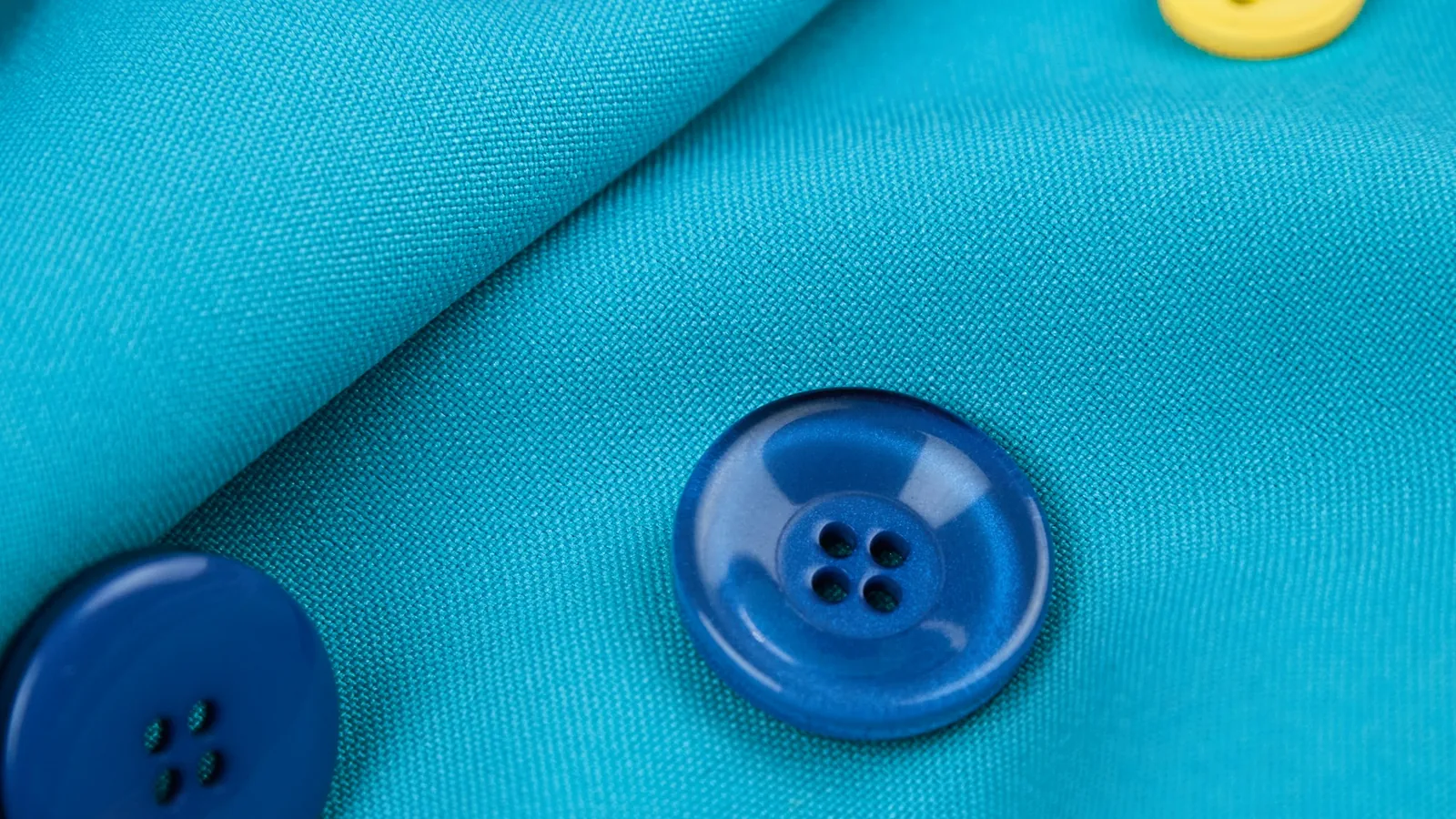
Compare button types, materials, sizes, finishes, attachment systems, buttonholes, care tests, and the details needed for production.
A button is a small component with a large effect on function, appearance, safety, care, and production. The right choice depends on how often the garment opens, the force at the closure, fabric thickness, wash or finishing processes, wearer dexterity, decoration, and the visual language of the product.
Button names are not enough for manufacturing. A useful specification identifies type, material, size, shape, color, holes or shank, finish, attachment method, placement, and performance expectations. This guide compares common options and shows how to approve them on the garment.
Compare buttons by attachment
Two-hole sew-through button
Thread passes through two visible holes into the garment. The clean face and simple stitch path work well on shirts, knitwear, uniforms, and casual garments. Hole size, spacing, thread, stitch count, and whether a thread shank is formed should match the fabric thickness and closure load.
Four-hole sew-through button
Four holes allow several visible stitch patterns and can distribute attachment. Cross, parallel, or decorative stitching changes the look, but strength still depends on button geometry, thread, machine setup, backing, and garment construction.
Shank button
A loop or post on the back holds the thread, leaving an uninterrupted decorative face. The built-in space can accommodate thicker fabric, coats, tailored products, and ornate styles. Check shank height, orientation, attachment access, and whether the button rotates or tips under load.
Covered button
Fabric is wrapped around a button form to match or contrast with the garment. Pattern placement, fabric bulk, fraying, backing, moisture, and pressing affect the result. A delicate covering can wear through at the edge, so test it in use.
The cut-and-sew guide explains how closures and trims should be developed alongside the pattern and construction rather than added after sampling.
Compare specialized button systems
| System | Typical use | Key specification |
|---|---|---|
| Jeans tack button | Denim waistbands and workwear | Cap, tack, post length, finish, setting force, pull strength |
| Snap or press fastener | Jackets, shirts, babywear, sportswear, pockets | Cap and socket system, size, spring, setting die, fabric reinforcement |
| Toggle | Outerwear and heritage closures | Length, hole or loop geometry, cord or tab attachment |
| Mandarin or frog closure button | Decorative loop closures | Hand or machine formation, symmetry, loop size, reinforcement |
| Stud or collar button | Removable formal closures | Post, head, backing, hole compatibility, small-part control |
| Magnetic closure | Selected adaptive, bag, or fashion uses | Magnet force, shielding, care, product restrictions, attachment |
Snaps and magnetic closures are fastening systems rather than conventional sewn buttons, but they are often considered at the same design stage. They need compatible setting equipment and product-specific safety review.
Choose button material
Common materials include polyester and other plastics, metal alloys, shell, corozo or other plant-derived materials, wood, horn-like composites, ceramic, glass, rubberized materials, and fabric-covered forms. Each has different color, weight, consistency, impact behavior, heat response, wash resistance, and sourcing evidence.
- Polyester or plastic: versatile color and shape; verify heat, impact, finish, and dye transfer.
- Metal: substantial and durable when specified well; check corrosion, plating, nickel requirements, weight, and wash chemistry.
- Shell or natural material: distinctive variation and luster; define acceptable variation, thickness, brittleness, and care.
- Wood or plant-derived material: tactile surface; evaluate moisture, cracking, color, finish, and traceability.
- Rubberized or coated button: soft-touch appearance; test coating adhesion, abrasion, heat, and aging.
Do not infer environmental benefit from a natural appearance or a single material attribute. Request evidence for any recycled, renewable, certified, or origin claim and state exactly which component it covers.
Specify size, shape, and finish
Button size may be given in millimetres or traditional line units. Record the unit, diameter, thickness, edge profile, hole dimensions, shank height, and weight where relevant. A small change can affect buttonhole length, placket bulk, machine feeding, and visual scale.
Specify round, square, domed, concave, flat, irregular, or custom shape with drawings or an approved sample. Define gloss, matte, brushed, antique, plated, dyed, laser-marked, engraved, or printed finish. For mottled or natural variation, approve a range rather than one perfect piece.
Color should be compared with the final dyed or washed garment under consistent lighting. A tonal button may need a deliberately different value to avoid looking like an accidental mismatch.
Match the button to the garment
Fabric weight and stability determine button size, shank space, backing, placket construction, and buttonhole. A heavy coat needs clearance for thick layers and enough support to resist distortion. A fine blouse needs a light component, clean holes, and a buttonhole that does not overwhelm the cloth.
Denim tack buttons must be approved after wash because chemicals, abrasion, and impact can change the finish or attachment. The custom jeans guide connects hardware with fabric, wash, waistband, and quality checks.
For children's products or garments sold into regulated work or protective markets, small parts, material restrictions, accessibility, or performance rules may apply. Verify current requirements for the exact product, age, and destination with qualified guidance.
Design buttonholes and placement together
A button and buttonhole are one system. Define buttonhole type, length, width, thread, density, bartack, orientation, and position. The opening must accommodate the button without releasing too easily or requiring unreasonable force.
Place closures from stable garment reference points and account for strain. Bust, waist, seat, cuff, and collar positions may need additional consideration. Test seated and moving positions for gaping. Mark the top, bottom, and directional orientation of decorative buttons so production does not rotate the motif.
Test attachment and care
- Approve the exact button, backing, thread or tack, and garment area.
- Check opening and closing force across repeated cycles.
- Assess pull strength and fabric damage using a method appropriate to the product.
- Run the intended washing, drying, pressing, dyeing, or garment-finishing process.
- Inspect cracking, corrosion, coating loss, sharp edges, color change, and looseness.
- Verify count, placement, orientation, and spare-button requirements in final inspection.
The quality guide shows how approved components and measurable checkpoints become part of bulk control.
Write a complete button specification
Include supplier article, type, material, dimensions, color, finish, logo artwork and orientation, hole or shank details, attachment method, thread or tack, buttonhole, placement, backing, care, testing, quantity, and acceptable variation. Keep an approved physical sample.
Coordinate button cards, spares, and packaging with the labels and packaging plan. A button may be small, but a controlled specification turns it from decoration into a reliable part of the garment.