
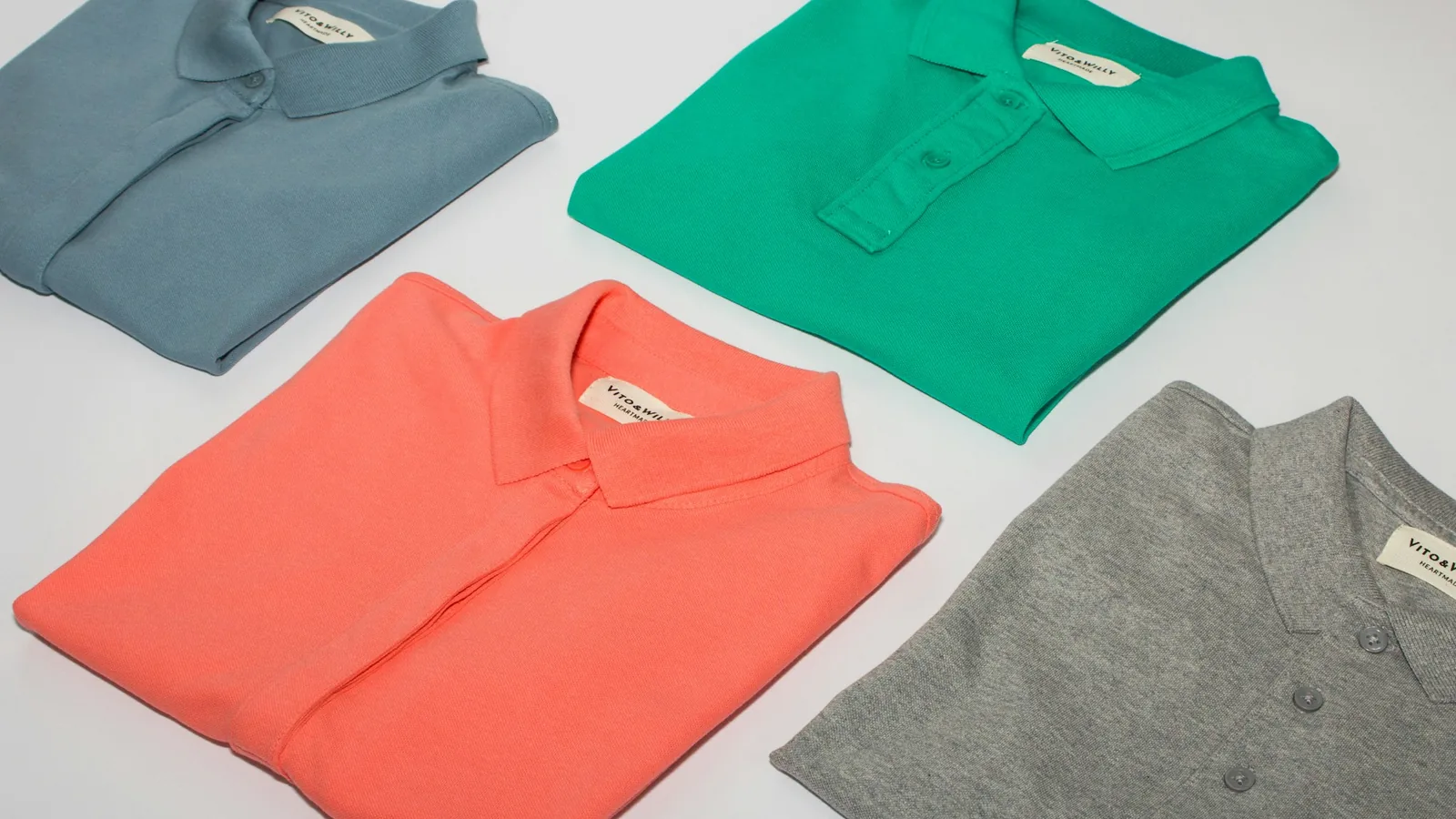
Compare golf-shirt fabrics, stretch, opacity, collars, plackets, decoration, fit, and testing to select a complete material system.
A golf shirt must balance presentation, movement, climate, care, and decoration. The material that feels impressive as a swatch may become heavy during play, show through when stretched, distort under embroidery, or lose its collar shape after care. Product teams should choose a fabric system, body, collar, placket support, thread, and branding, against a written use brief and test the complete shirt.
Write the use brief
Define where and how the shirt will be worn. A warm-weather performance polo, a clubhouse-to-office style, a team uniform, and a premium lifestyle piece have different priorities. Record climate, intensity, fit, layering, expected care, brand position, decoration, and price architecture.
Rank the requirements. If the shirt must retain a crisp appearance through repeated commercial laundering, that may outweigh an exceptionally soft first touch. If unrestricted swing movement is central, pattern and stretch behavior matter together. Review product possibilities on the custom golf shirt page before choosing material in isolation.
Compare common material directions
| Material direction | Potential strengths | Questions for development |
|---|---|---|
| Cotton pique | Recognizable texture, natural hand, structured casual appearance | What are shrinkage, drying behavior, and colorfastness? |
| Cotton-rich blend | Familiar hand with added resilience from the blend | Does it pill, twist, or retain its silhouette after care? |
| Polyester performance knit | Low wet weight and compatibility with performance finishes | Is it opaque, snag resistant, colorfast, and comfortable? |
| Polyester-elastane jersey | Stretch for close or athletic fits | Does it recover, remain stable under heat, and support decoration? |
| Merino-rich blend | Refined natural hand and temperature versatility | Is care, abrasion performance, and cost suitable for the customer? |
Fiber content does not determine performance by itself. Yarn, knit structure, weight, finishing, dyeing, and garment construction all matter. Request the full specification and avoid treating "moisture wicking" as proven until the nominated fabric and finish have appropriate test evidence.
Evaluate weight, stretch, and opacity
Fabric weight influences substance, drape, and coverage, but it must be read with structure. A light compact knit may provide better coverage than a heavier open construction. View light and dark colors under strong lighting, relaxed and stretched, on the body.
Measure stretch and recovery in both directions. A pattern can provide movement through ease, gussets, or sleeve shape, so more elastane is not always necessary. Excessive stretch with poor recovery can leave the placket, shoulders, or hem looking tired. Test after repeated movement and care.
Assess airflow and drying in the intended climate through wear trials rather than assuming one fiber solves every condition. Place testers in the actual activity, then record heat zones, cling, wet weight, rubbing, and whether the shirt remains presentable after the session.
Design the collar and placket system
The collar gives a golf shirt much of its identity. Options include a flat-knit collar, self-fabric collar, rib collar, or more engineered structure. Each needs compatible recovery, weight, and care. A collar that is too soft may collapse; one that is too heavy can pull the neckline or feel formal in the wrong way.
Specify collar dimensions, stand or roll direction, edge finish, tipping or stripe, and approved relaxation. The placket requires length, width, layer, reinforcement, button size, spacing, and stitch details. Stabilizers should provide control without creating visible stiffness or bubbling.
Coordinate the body with cuffs, collar, buttons, thread, neck tape, and labels. Different materials may need tonal approval rather than an assumed exact dye match. The custom polo guide helps connect these components to the final product.
Plan fit, construction, and branding
Test shoulder movement, sleeve opening, across-back width, body length, hem vents, and placket behavior during a full swing and while bending. A slim silhouette needs enough movement without relying on fabric stretch to correct a restrictive pattern. A relaxed fit should still control excess volume around the armhole and waist.
Embroidery is common on golf shirts, but stitch density, backing, needle, placement, and fabric stability affect the result. Make the actual logo at production size on the nominated cloth. Lightweight or highly elastic fabric may need a different solution from substantial pique. For prints or transfers, test adhesion, hand, heat response, and color migration.
Specify thread, seam type, stitch appearance, hem finish, vent construction, and any shoulder or side inserts. Review the inside as carefully as the outside: rough backing, bulky seams, or a poorly placed label can become distracting during repeated movement. Confirm that every construction choice remains stable after the proposed care cycle.
Test the complete shirt
Measure the sample before and after the proposed care process. Review shrinkage, twist, collar and placket appearance, seam puckering, color change, pilling, snagging, stretch recovery, and decoration durability. Wear-test in relevant heat and movement. Check whether a bag strap or repeated club movement abrades high-contact areas.
Define pass criteria in the quality plan. If the shirt is part of a uniform program, include repeat-order color and component control. If it will be sold in several markets, confirm applicable labeling and safety requirements rather than assuming one set of instructions is universal.
Record each wear trial with the wearer's measurements, sample size, conditions, duration, and observations. That makes feedback comparable and separates a pattern issue from a preference. Recheck any corrected sample against the original scorecard before approving the material and construction together.
Prepare a golf-shirt material brief
Include product use, climate, fit, body fabric specification, collar and cuff construction, placket, stretch, color, decoration, care, size range, quantity, destination, and testing needs. Attach reference swatches and indicate which qualities are essential versus open to alternatives.
The capabilities overview maps sourcing, sampling, decoration, and finishing. Once the scorecard is ready, send the golf shirt brief. The strongest material choice is not a fashionable fiber label; it is a tested system that supports movement, presentation, and repeatable production.