
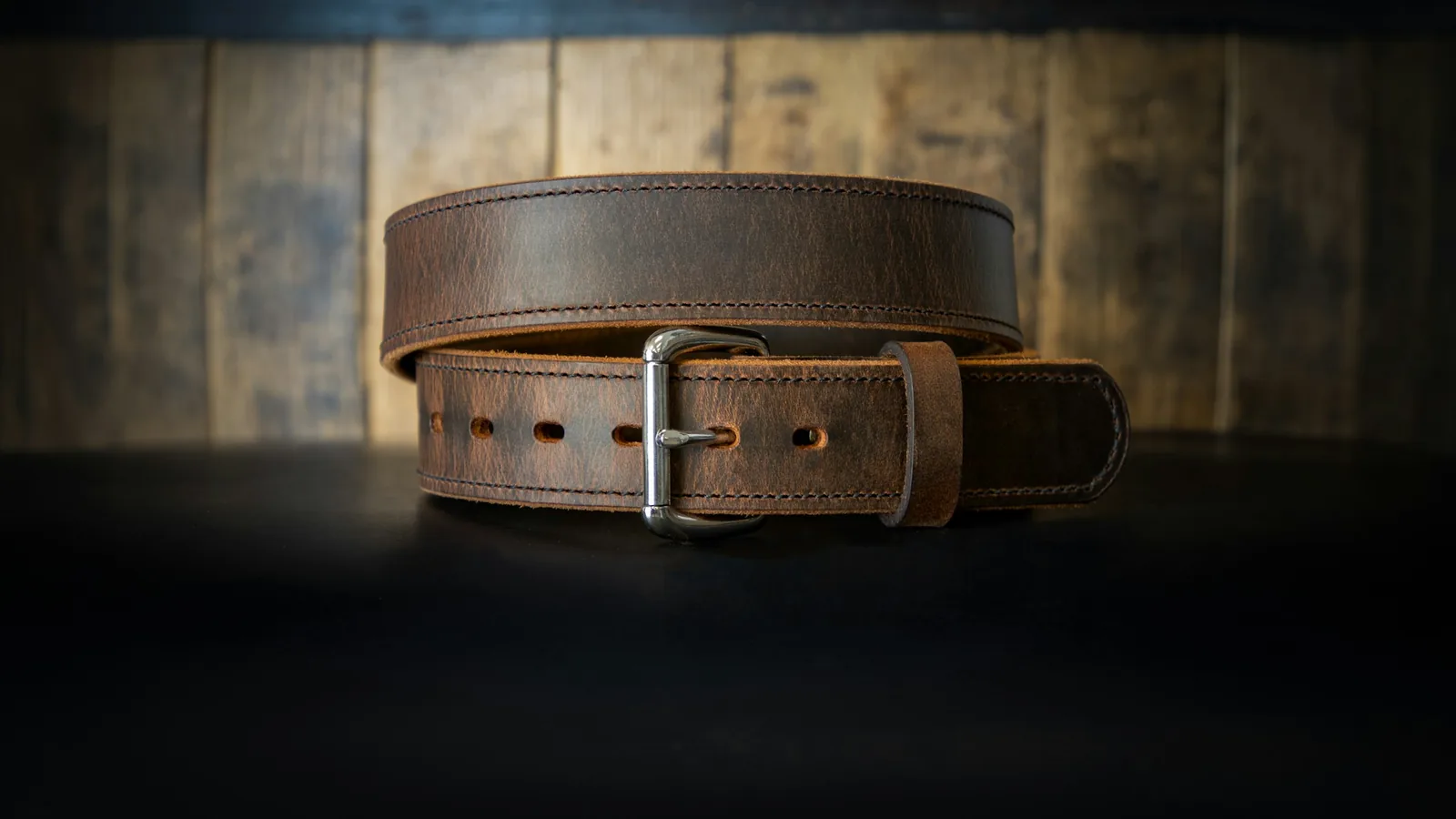
Evaluate belt suppliers through material truth, sizing, hardware, edge finishing, production verification, testing, packing, and complete cost.
A belt supplier should be evaluated against the material, construction, hardware, sizing, finish, and labeling the product actually needs. "Best belt manufacturer" has no durable meaning without that context. A dress belt, reversible bonded belt, webbing belt, braided style, and technical work belt use different processes. These ten checks turn a broad search into a verifiable sourcing brief.
1-2. Define the belt type and material truthfully
Start with use, customer, width, thickness, size range, stiffness, edge, buckle, adjustment, color, branding, packaging, and quantity. Supply an exploded drawing showing every layer. A single-layer strap behaves differently from a laminated belt with face material, reinforcement, filler, lining, and painted edges.
Ask the supplier to identify each material precisely. Full-grain, top-grain, split, bonded leather fiber material, coated textile, polyurethane, webbing, and imitation leather should not be treated as interchangeable descriptions. If leather terminology will appear in US marketing, the official FTC leather-product guides in 16 CFR Part 24 provide authoritative context.
| Check | Evidence to request | Why it matters |
|---|---|---|
| 3. Strap build | Layer map, thickness, reinforcement and adhesive | Controls stretch, edge and service behavior |
| 4. Hardware | Base metal, finish, dimensions, attachment and test data | A buckle can dominate weight and failure risk |
| 5. Sizing | Measurement method, hole positions, grade and tolerance | Nominal waist size is not a finished belt length |
| 6. Edges | Cut, fold, paint, burnish, stitch and approved cross-section | Edges reveal material and process consistency |
| 7. Decoration | Emboss, deboss, print, engraving or label sample | Method must suit the surface and scale |
| 8. Testing | Flex, pull, finish, corrosion and care plan by use | Claims need a defined method |
| 9. Factory | Actual production address and subcontracted operations | Trader and factory roles should be transparent |
| 10. Quote | Itemized materials, tooling, MOQ, packing and freight | Comparable scope prevents false savings |
3-4. Inspect strap construction and hardware
Request a cut cross-section or material stack sample. Confirm how layers are skived, joined, stitched, folded, bonded, or reinforced around holes and the buckle. Check whether adhesive remains stable under expected temperature and flexing. Reversible mechanisms need repeated operation and a clear way to control twisting.
Hardware specifications should include base material, plating or coating, dimensions, weight, buckle type, prong, roller, keeper, rivet, screw, and attachment. Ask which finishes are stock and which require custom tooling or minimums. If nickel, corrosion, pull strength, or restricted-substance requirements apply, state the market and evidence expected.
5-7. Approve sizing, edge finish, and branding
Define how belt size is measured, commonly from a named buckle point to a named hole, and provide a diagram. Record overall length, center-hole position, hole spacing, number of holes, tip length, buckle dimensions, and tolerance. Fit-test with the intended garment rise because a waist and hip belt may need different ranges.
Edge choices include raw cut, folded, stitched, painted, burnished, bound, or sealed. Review color, smoothness, flexibility, layer visibility, cracking, and overspill after flexing. Painted edges often require several controlled operations and drying time.
Branding can use embossing, debossing, foil, printing, engraving, woven labels, metal logos, or custom buckles. Approve size, depth, placement, color, backing, and reverse appearance. Avoid placing a stiff logo where the belt must bend tightly.
8. Test a production-representative belt
Testing should follow the use. Check buckle attachment, prong and hole deformation, keeper security, flexing, layer separation, edge cracking, finish rub, color transfer, screw loosening, and dimensional change. A fashion belt does not need the same load claim as protective equipment; do not imply safety performance without the relevant standard and validation.
Condition and test the final material, hardware finish, and construction. A result for a loose buckle or different strap does not validate the complete belt. Keep the approved sample and signed specification as the bulk reference.
9. Verify the production arrangement
Ask whether the candidate is a factory, workshop, sourcing company, or brand-facing agent. None is automatically unsuitable, but the role must be clear. Verify legal business identity, production address, material suppliers, subcontracted plating or finishing, inspection responsibility, and permission to visit or use independent inspection.
Request evidence for relevant recent products without asking for confidential customer information. A supplier of inexpensive webbing belts may not have the skiving, edge painting, or hardware sourcing needed for a refined leather-style product.
10. Compare complete commercial terms
Normalize currency, Incoterm, material grade, buckle finish, custom molds, sample fee, size and color minimums, packaging, testing, inspection, lead time, payment, freight, and replacement terms. Ask how material yield and hardware minimums affect price. Record what happens if the approved material becomes unavailable.
Approve a size set and production pilot
Do not extrapolate every belt from one attractive sample. Review the shortest, middle, and longest sizes for total length, hole sequence, buckle-to-center-hole measurement, keeper position, tip proportion, and logo placement. Longer straps may expose different yield, splicing, edge, or stiffness problems, while small sizes can distort decorative spacing.
Use a pilot to check material lot, cut direction, thickness after skiving, layer adhesion, edge finish, hole quality, stitching, hardware attachment, surface protection, packing, and repeated flex. Inspect several pieces rather than the presentation sample. Record acceptable natural variation for leather-like materials and define defects that cannot be sold.
Retain the approved strap standard, buckle and finish reference, die or pattern, size chart, component source, test results, inspection report, and one sealed production belt. On a reorder, reconfirm material and plating lots before assuming the prior appearance will repeat.
For a stronger enquiry, use the custom belt development page, review labels and packaging, follow the ordering workflow, and check the quality process.
Supplier capabilities, ownership, minimums, locations, and commercial terms change. Treat any comparison as a starting point and verify current details directly before making a purchasing decision.